
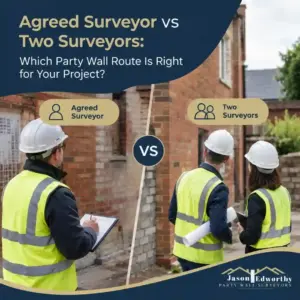
Planning an extension, loft conversion or structural work on your home? If the Party Wall Act applies, you’ll need to decide whether to use one agreed surveyor or appoint separate surveyors for you and your neighbour.
Under the Party Wall etc. Act 1996, the appropriate procedure depends on the proposed work, the response to your party wall notice and whether the owners agree on how to proceed. Choosing the right route can make the process more straightforward, but it is important to understand what each option involves before making a decision.
At Jason Edworthy Surveyors Bristol, we believe that clear, practical guidance helps building owners and adjoining owners make informed decisions about party wall matters.
What Is the Difference Between an Agreed Surveyor and Two Party Wall Surveyors?
An agreed surveyor is appointed to deal with the party wall matters on behalf of both the building owner and the adjoining owner. Under the Party Wall etc. Act 1996, they must remain impartial and deal fairly with the issues that arise during the process.
With two surveyors, the building owner appoints one surveyor and the adjoining owner appoints another. These surveyors work together to resolve the matters in dispute and prepare a party wall award where required. If they cannot agree, a third surveyor can be selected in accordance with the Act.
The main difference is the appointment structure, not whether the parties are entitled to fair treatment. An agreed surveyor does not act as the building owner’s personal representative, while two surveyors do not automatically guarantee a better outcome. Read Also: Integrating Party Wall Compliance Into Your Project Programme: A Guide for Architects
Both routes can provide a formal process for addressing relevant matters, such as the rights of the parties, the timing of work, access requirements and the protection of adjoining property.

Is Appointing One Agreed Surveyor Cheaper Than Hiring Two Surveyors?
Cost is an important consideration for homeowners planning building work. Appointing an agreed surveyor may help keep costs down, as both property owners use the same surveyor instead of appointing one each.
However, the actual cost depends on the complexity of the project, the time required, the condition of neighbouring property and the issues that need to be resolved.
For example, a straightforward rear extension may require less investigation and negotiation than a basement excavation close to a neighbouring property’s foundations. Even where one surveyor is appointed, complex work can still require considerable professional input.
Using two surveyors can mean additional costs because each needs to review the information and work with the other surveyor. However, having a surveyor of their own may be the right choice for an adjoining owner who wants independent advice and representation.
It is also important to understand who normally pays. Where the building owner’s work makes an award necessary, the building owner will commonly be responsible for reasonable surveyors’ fees associated with the statutory process, subject to the circumstances and the applicable legal principles.
The practical takeaway: Ask for a clear explanation of the proposed fees, the work included and the factors that could increase costs. The cheapest initial quote does not necessarily mean the lowest overall cost.
Can You Trust an Agreed Surveyor to Protect Your Interests?
Some adjoining owners worry that an agreed surveyor might favour the building owner because the building owner is paying the fees. This concern is understandable, particularly when the proposed work could affect a shared wall, cause disruption or raise questions about potential damage.
However, an agreed surveyor must act impartially in carrying out the statutory role. Their responsibility is not to secure the preferred outcome for the person paying the bill, but to deal fairly with the relevant matters under the Act.
An agreed surveyor may be suitable where both owners understand the process, are comfortable with the appointment and have no significant concerns about the proposed work.
If either owner is uncomfortable with a joint appointment, separate surveyors may provide greater reassurance. Each owner can obtain advice from their appointed surveyor, while the surveyors work together under the statutory procedure. Check This One Also: Buying or Selling a House With Ongoing Party Wall Works: What Every Buyer and Seller Needs to Know
Appointing two surveyors does not mean either can ignore the law or act solely in their client’s interests. Both have a legal duty to carry out their responsibilities properly and fairly.
At Jason Edworthy Surveyors Bristol, the priority should be helping clients understand their options, the surveyor’s duties and the practical implications of each appointment route before proceeding.
When Is It Better for Each Neighbour to Appoint Their Own Party Wall Surveyor?
Separate surveyors may be particularly helpful where the proposed work is complex, the potential consequences are significant or the owners have different concerns.
Consider these examples:
- A basement excavation: The adjoining owner may be concerned about ground movement, foundations and possible damage to their property.
- A loft conversion: Structural alterations and work involving a party wall may raise questions about protection, access and the sequence of construction.
- Removing a chimney breast: The owners may need clarity about structural implications and the work affecting the party wall.
- An existing crack in a neighbouring property: A schedule of condition can help document the property’s visible condition before relevant work starts.
- A difficult neighbour relationship: Separate surveyors may help ensure that technical concerns are addressed through a structured professional process.
These examples do not mean that two surveyors are always necessary for complex projects. An experienced agreed surveyor may also deal with complicated matters where both owners are comfortable with the arrangement.
The key question is whether both owners can agree on the appointment and whether the proposed arrangement is suitable for the work involved.
Will Choosing One Surveyor or Two Affect Your Party Wall Award Timeline?
Time matters when you have builders booked, materials ordered or a completion date to meet. The surveyor appointment route can influence the process, but neither option guarantees a faster award.
An agreed surveyor may be able to coordinate discussions through one appointment, potentially reducing administrative duplication. However, progress can still be delayed by incomplete drawings, unanswered questions, access difficulties or concerns about the proposed work.
When two surveyors are involved, communication and coordination between them can sometimes take extra time. However, clearly defined roles and timely cooperation can help the process run smoothly.
A schedule of condition can also be prepared before construction starts to document the visible state of the adjoining property. This record may be useful if any concerns about potential damage arise during or after the work. See Also: Schedule of Condition: Why It’s the Most Important Document in Your Building Project
It’s easy to confuse a party wall notice with a party wall award, but they’re not the same thing. A notice informs the adjoining owner about the proposed work, whereas an award sets out the relevant matters determined under the Act when the formal dispute resolution procedure is required.
Speak to your surveyor early, provide accurate drawings and explain your proposed timetable. Starting the party wall process in good time is generally more helpful than assuming that one appointment route will automatically prevent delays.

What Happens If You and Your Neighbour Disagree About the Surveyor or Party Wall Award?
Disagreements can arise even when both owners initially intend to cooperate.
If an adjoining owner Bristol does not consent to a valid party wall notice within the applicable period, a dispute may arise under the Act. The owners can then agree to appoint one surveyor or appoint separate surveyors in accordance with the statutory procedure.
An adjoining owner should not assume that refusing to respond will stop the process indefinitely. Equally, a building owner should not assume that serving a notice gives automatic permission to begin all proposed work.
If you receive a party wall award, take the time to read through it properly so you know what is expected of you. If anything is unclear, ask for an explanation before taking further action. If you disagree with the award, you can generally appeal to the County Court within 14 days of it being served.
Changing surveyors partway through the process can also be more complicated than you might expect. The next steps will depend on the appointments already in place and how far things have progressed. It is worth getting professional advice before making any changes. Check this article also: Party Wall Surveyor Fees Explained: Who Pays, How Much, and Why
Keeping communication factual, retaining relevant documents and addressing concerns promptly can help prevent avoidable escalation.
How Can Jason Edworthy Surveyors Help You Choose the Right Party Wall Procedure?
Choosing between an agreed surveyor and two surveyors should be based on your project rather than a general assumption that one route is always better.
Jason Edworthy Surveyors Bristol can help property owners understand the party wall procedure, identify the issues that may need professional attention and consider which appointment arrangement is appropriate for their circumstances.
Before making a decision, consider:
- What work are you planning, and does it fall within the Party Wall etc. Act 1996?
- Has your neighbour raised concerns about structural work, access or potential damage?
- Are both owners comfortable with appointing one impartial surveyor?
- Would separate appointments provide additional reassurance given the circumstances?
- Have you allowed enough time for notices, appointments and any necessary award?
Understanding these questions early can help you plan more confidently, manage expectations and reduce the risk of avoidable disputes.
Contact Jason Edworthy Surveyors Bristol to discuss your proposed building work and obtain guidance on the appropriate party wall procedure for your project.
FAQs
Q: Do my neighbour and I both need our own party wall surveyor Bristol?
Not necessarily. If you both agree, you can use the same surveyor to deal with the party wall matter. The important thing is that the surveyor acts fairly and independently for both sides.
Q: Does an agreed surveyor work for the building owner or adjoining owner?
Neither in the sense of acting as an individual owner’s advocate. An agreed surveyor acts impartially for the purposes of the Party Wall etc. Act 1996.
Q: Who pays the fees when two party wall surveyors are appointed?
The building owner will usually cover the reasonable fees for both party wall surveyors when their appointment is needed under the legal process. However, the final cost can depend on the circumstances.
Q: Can my neighbour insist on appointing their own party wall surveyor Bristol?
Where a dispute has arisen under the Act, an adjoining owner can generally appoint their own surveyor rather than agree to a single surveyor. The appointment must follow the statutory procedure.
Q: Can I change from an agreed surveyor to two surveyors if a dispute develops?
Not necessarily at will. The existing appointment, the stage of the process and the Act’s provisions affect what can be done. It’s best to get advice before making any changes to the arrangement.
Q: Which option is best for a house extension or loft conversion Bristol?
Either route may be suitable. The decision depends on the work, the owners’ agreement, the concerns involved and the complexity of the statutory matters that need to be addressed.
For further information, please call US on 03300 101 381